Cracking the Code on Progressive Lenses Price
Cracking the Code on Progressive Lenses Price
【Decoding Progressive Lenses: What Are You Paying For?】
Struggling to understand the huge range in the progressive lenses price? You're not just paying for frames; you're investing in a complex combination of advanced technology, custom fitting, and brand innovation. This guide decodes every factor, empowering you to make an informed decision without overpaying. To find the perfect balance of quality and cost for your specific needs, start by exploring a direct comparison of progressive lenses price options.
Ever wondered why the cost of progressive lenses can vary so much? You're not alone. The final price tag is a complex mix of technology, customization, and brand reputation. Let's break down exactly what you're investing in when you purchase a pair.
First, What Exactly Are Progressive Lenses?
Before we talk about the price, what are these lenses? Think of them as the next evolution of bifocals and trifocals, but designed for the modern world.
A Modern Marvel for Your Eyes
Imagine a pair of glasses that lets you see clearly at any distance, all without those distracting lines you see on traditional bifocals. That's the magic of a progressive lens.
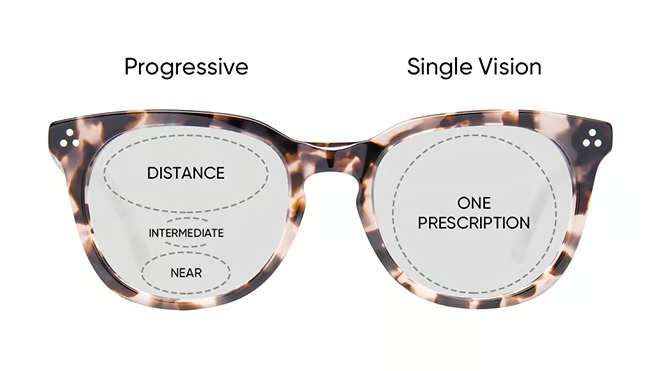
They feature a seamless, gradual transition between different prescription strengths. At the top, you have your distance vision. In the middle, there's an intermediate zone for computer work. At the bottom, you have your near-vision zone for reading. This design is perfect for dynamic activities like driving, allowing you to clearly see the road ahead, your dashboard, and your GPS with a simple, natural shift of your eyes.
Why Are Progressive Lenses So Expensive?
So, what's behind the high cost? The `progressive lenses price` is a reflection of advanced manufacturing, precise personalization, and the research that goes into creating them.
The "No-Line" Difference: Advanced Lens Technology
The seamless transition isn't just for looks; it requires incredibly sophisticated technology. Unlike a single-vision lens with one prescription, a progressive lens has a complex surface curvature that is digitally engineered with extreme precision.
This advanced "digital surfacing" technology carves a unique visual corridor onto the lens, eliminating the abrupt image jumps found in lined bifocals. The result is a much more natural and comfortable viewing experience, but this complex manufacturing process is a primary driver of the cost.
Customization Is King
A progressive lens is not a one-size-fits-all product. For it to work correctly, it must be perfectly tailored to you. This goes far beyond just your prescription.
Crucial measurements like your pupillary distance (PD), the specific position of your eyes within the frame (segment height), and even the way the frame rests on your face are all critical. Some premium retailers like ROKA even have you take a selfie while wearing the frames to ensure these prescription zones are placed perfectly for your eyes. This high degree of personalization is essential for clear vision and is a significant part of the overall price.
It’s All in the Brand Name
Finally, the brand of the lens plays a huge role. Major lens manufacturers like Essilor (creators of the Varilux brand), ZEISS, and HOYA are leaders in the optical industry.
These companies invest millions in research and development to create lenses with wider viewing corridors, less peripheral distortion (the "swim" effect), and enhanced clarity. This ongoing innovation is directly reflected in the `progressive lenses price`. When you choose a reputable brand, you're paying for decades of optical engineering and proven performance.
To see how these different technologies, customization levels, and brands impact the final cost in 2025, it's helpful to see a direct comparison. You can explore a variety of choices to find the perfect fit for your visual needs and budget. For a detailed breakdown, you can compare progressive lenses price options here.
【The Ultimate 2025 Retailer Price & Quality Showdown】
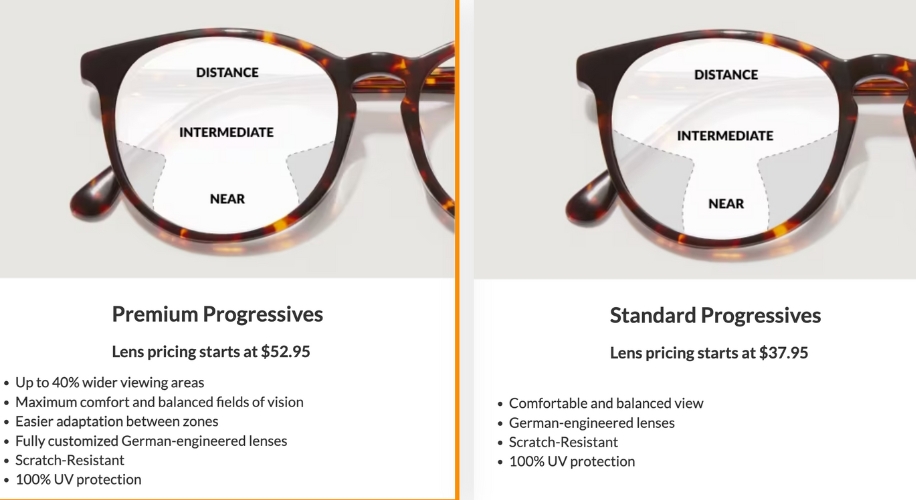
When it comes to buying progressive lenses, where you shop matters—a lot. The retailer you choose affects not just the price, but also the quality of the lenses, the accuracy of the fit, and the customer service you receive. Let's compare the biggest names in the game.
Costco Optical: What is the Price for the People's Champion?
Costco Optical consistently earns top marks for value and service, but how does it stack up for progressives?
Average Starting Price (Single-Vision Basis)
Their pricing model is attractive. You can get frames starting around $60 and basic single-vision lenses for about $66, putting a simple pair of glasses near $133. Progressive lenses, of course, are an additional charge on top of this.
The Pros: Why It's #1 at Consumer Reports
Why does Consumer Reports rank them #1? It often comes down to exceptional customer service. One customer shared a story where their optometrist made an error on the prescription, and Costco replaced the lenses for free, no questions asked. This level of follow-up service builds immense trust.
The Cons: Not Always a Perfect Fit
However, it's not always a perfect experience. Some reviews point to durability issues, with lenses developing "tiny scratches/pitting within 2 months." Furthermore, their labs may have limitations. If you have a complex prescription or specialty frames, like performance eyewear from ROKA, they might not be able to handle the job, returning them as "not possible" to fit with progressives.
While the starting cost is low, the final `progressive lenses price` can vary. It’s crucial to weigh their service against potential limitations with lens durability and complex fittings. To see how Costco's all-in price compares to others, it's smart to check other progressive lens prices and ensure you're getting the best technology for your specific needs.
Warby Parker: How Does Style Affect the Progressive Lenses Price?
Warby Parker has become a giant in the eyewear space, known for its stylish frames and convenient shopping experience. They sit right behind Costco at #2 in Consumer Reports' rankings.
The Value Proposition
Their famous "try five frames at home for free" program has revolutionized how people buy glasses. Many locations also offer comprehensive eye exams, typically costing between $85 and $130, making it a convenient one-stop shop.
The Progressive Upcharge
But what about the progressive lens upcharge? Here, the price aligns more with specialty brands. Adding progressive lenses is a significant cost, reportedly a $200+ addition to the frame price. This elevates a stylish, affordable frame into a more premium-priced piece of essential gear.
Understanding how this upcharge impacts the total `progressive lenses price` is key to managing your budget. To get a clear overview of how this cost stacks up against other retailers, exploring a detailed progressive lenses price comparison is your best next step.
Zenni Optical: Is the Ultra-Budget Price Worth It?
If you're looking for the absolute lowest price point, Zenni is impossible to ignore. With frames and basic lenses starting at an astonishing $6.95, they are the definition of a budget disruptor.
The Quality Question: A Slipping Reputation
However, there's a growing concern about quality. Zenni's reputation has taken a hit, dropping from a respectable #3 spot all the way down to #11 in Consumer Reports' rankings. Money expert Clark Howard even noted that its score plummeted from "great" to what he now considers a "failing score."
So, Are Cheap Progressive Lenses Any Good?
The rock-bottom `progressive lenses price` comes with a clear trade-off. You might save a significant amount of money upfront, but you're taking a gamble on optical quality, durability, and customer service if something goes wrong. It's a risk you must be willing to weigh.
If you are tempted by the budget route, it's vital to see what even a small step up in price can get you in terms of quality and reliability. You can evaluate various progressive lenses price ranges to find that sweet spot between cost and long-term satisfaction.
Other Noteworthy Contenders and Their Pricing Models
The market is filled with other great options, each with a unique approach to pricing their progressive lenses.
America's Best: The All-in-One Deal
* **America's Best:** They focus on all-in-one deals. A popular offer includes two pairs of progressive glasses plus an eye exam for a total of $159.95, providing incredible upfront value.
Owndays: The Simple Add-On
* **Owndays:** This retailer simplifies the process. They offer progressive lenses as a simple, flat $100 add-on to the price of any frame you choose. This transparent pricing makes it easy to calculate your final cost.
ROKA: The Performance Specialist
* **ROKA:** As a performance specialist, ROKA caters to an active clientele. They charge a $200 upcharge for progressive lenses on their high-performance frames. This means a $200 pair of frames becomes a $400 pair of high-tech glasses.
These varied pricing structures show just how different the final `progressive lenses price` can be from one retailer to another. To make the most informed decision for your vision and wallet in 2025, seeing all these options side-by-side is a powerful tool. Take a look at this comprehensive progressive lenses price list to find the best deal for you.
【Key Factors That Skyrocket Your Progressive Lens Price】
You've seen the price differences between retailers, but what's happening behind the scenes to create such a wide range? The final cost on your bill isn't just about the brand name; it's determined by the specific materials, technology, and treatments you choose.
Let's break down the three main factors that can dramatically increase your progressive lens price in 2025.
Lens Material: A Key Driver of Your High Index Progressive Lenses Cost
Think of lens material as the foundation of your glasses. The material you choose impacts thickness, weight, and clarity—and, of course, the price.
The Baseline: Plastic & Polycarbonate
Your most affordable options are standard plastic (CR-39) and polycarbonate. These are the workhorses of the eyewear industry, suitable for many common prescriptions. They get the job done without breaking the bank.
High-Index Lenses: Thinner, Lighter, Pricier
But what if you have a strong prescription? This is where high-index lenses become essential. To avoid the thick, heavy "coke bottle" effect, these advanced materials bend light more efficiently, allowing the lens to be significantly thinner and lighter. This not only looks better but also reduces the distortion you might see at the edges of the lens. Some retailers, like Owndays, even include a 1.60 high-index lens as a standard feature. However, for most, upgrading to 1.67 or 1.74 high-index materials will increase the `high index progressive lenses cost`.
Understanding how this material choice affects your final bill is crucial for budgeting. To see the price difference for yourself, you can compare high-index lens prices from various suppliers and decide if the thinner, lighter profile is worth the investment for your prescription.
Lens Technology: Comparing the Digital vs Standard Progressive Lenses Price
Not all progressive lenses are created equal. The technology used to craft the vision corridors in your lenses is one of the biggest price differentiators.
Standard Progressive Lenses
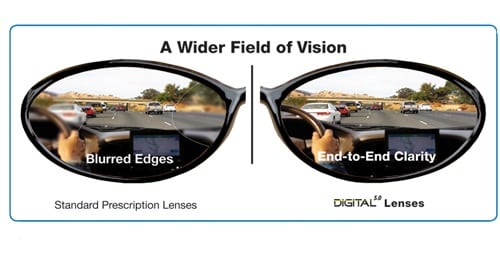
Standard progressive lenses are made using older, pre-molded designs. Think of it as an "off-the-rack" solution. It offers a one-size-fits-all corridor for transitioning between near, intermediate, and distance vision. While more affordable, this often results in a narrower field of clear vision and more noticeable peripheral distortion, sometimes called "swim."
Digital "Free-Form" Progressive Lenses
Digital "Free-Form" progressive lenses, on the other hand, are the "custom-tailored" equivalent. Using advanced computer-guided surfacing, the lab custom-maps your unique prescription and frame choice point-by-point onto the lens. This results in a much wider, clearer viewing area with significantly less distortion. The visual experience is sharper and more natural. This advanced customization is the primary reason the `digital vs standard progressive lenses price` can be so different.
Is the upgrade to digital technology worth the extra cost for you? Exploring real-world pricing can help you decide. By checking a list of digital progressive lens costs, you can weigh the benefits of a wider, clearer view against your budget.
Coatings and Add-Ons: What is the Upcharge for Progressive Lenses Features?
Finally, we have the add-ons—the features that can quickly inflate your total bill. While some are essential for lens longevity and comfort, they are often presented as upcharges that can catch you by surprise.
What is the upcharge for progressive lenses features?
These are the most common coatings that will add to your final price:
* **Transitions (Photochromic):** Want lenses that automatically darken in sunlight? This convenient feature is a popular add-on that can easily add $100 or more to your bill.
* **Blue-Light Filtering:** Marketed for heavy computer and screen use, a quality blue-light filter is another common upcharge. Retailers like Owndays, for example, list this as an approximately $100 addition.
* **Anti-Reflective & Scratch-Resistant Coatings:** While many retailers include a basic version of these coatings, premium versions that offer superior glare reduction, smudge resistance, and durability will come at an extra cost.
These individual features can stack up, significantly raising the overall `eyewear cost`. To avoid surprises at checkout, it's vital to know the all-in price. The best way to do this is to check total eyewear cost with add-ons so you can compare the final price, not just the starting price, from different sellers.
【Your Action Plan: How to Get the Best Value】
Navigating the world of progressive lenses can feel complex, but with the right strategy, you can find the perfect pair without overpaying. Here is your actionable plan to secure the best possible value on your next purchase in 2025.
Your Checklist Before Checking the Progressive Lenses Price
Before you even start comparing retailers, you need to get your essential information in order. Skipping these steps is a recipe for frustration and extra costs.
Get Your Full Prescription and Pupillary Distance (PD)
You absolutely need both of these to order glasses, especially online. The PD, or pupillary distance, is the measurement between the centers of your pupils. It's crucial for aligning the different vision zones of a progressive lens correctly.
Under the FTC's Eyeglass Rule, your eye doctor must provide you with your prescription upon request. However, they are not always required to include your PD. Make sure to ask for it specifically during your exam.
Factor in the Eye Exam Cost
Don't forget that the eye exam is a separate fee. This cost is not part of the price of the lenses or frames. In 2025, expect this to range from about $70 at a store like Costco to well over $100 at a private optometry office. This is a foundational part of your total budget.
Research Your Lens Replacement Options
Do you love the frames you already have? You might not need new ones. Some retailers, like Owndays, offer a `progressive lens replacement cost` service, allowing them to put new progressive lenses into your existing frames. This can be a smart way to save money.
Getting these details sorted first allows you to compare offers accurately. To see how these factors influence the final bill, it’s helpful to review the complete progressive lenses price from different vendors, so you can see the all-in cost before making a decision.
So, Are Expensive Progressive Lenses Worth It?
This is the big question. Does a higher price tag actually translate to a better visual experience? The answer depends entirely on your lifestyle, your prescription, and your personal priorities.
The Case for "Yes, They Are Worth It"
For many people, the answer is a resounding yes. If you lead an active life, you'll feel the difference in high-quality performance frames, like those from ROKA, that are designed to stay put.
More importantly, the technology in premium lenses makes a tangible impact. Digital free-form progressive lenses provide a demonstrably wider field of clear vision. This wider "corridor" drastically reduces peripheral distortion and makes `getting used to new progressive lenses` much faster and easier.
The Case for "Maybe Not for Everyone"
However, a premium pair isn't a necessity for everyone. If you have a relatively simple prescription and are working with a strict budget, a more affordable option might be perfectly adequate for your needs.
Retailers like America's Best or even online-only shops like Zenni offer functional progressive lenses that get the job done for a fraction of the cost. They may have narrower viewing corridors and require a longer adaptation period, but they make clear vision accessible.
Ultimately, the "worth" is personal. To make an informed choice, you need to understand the value proposition at each price point. Investigating the cost differences between basic and premium progressive lenses will help you determine if the benefits of high-end features align with your daily needs and budget.
A Pro Tip for First-Time Buyers to Judge Online Progressive Lenses Price
Feeling nervous about ordering a complex lens like a progressive online for the first time? You're not alone. It can feel like a big risk. Here’s a low-risk strategy to find out if online retailers are right for you.
Clark Howard's "Safe Harbor" Strategy
Consumer expert Clark Howard suggests a "safe harbor" approach. For your first pair of progressives, buy from a traditional, brick-and-mortar retailer. This gives you a physical point of contact for adjustments and establishes a quality baseline. You'll know what a professionally fitted pair feels like.
Then, for your second or backup pair, order from a budget-friendly online store like Zenni. This is your low-cost experiment. You can directly compare the online pair to your professionally fitted one. See if the quality is sufficient for your needs. You might find the budget option works great, saving you hundreds on future purchases.
This strategy empowers you to make future decisions based on your own experience. To start this process, you can compare the progressive lenses price between online and in-store options to see just how much you could potentially save on that experimental second pair.
【Your Final Guide to Finding the Best Progressive Lens Value】
Choosing the right progressive lenses is a significant decision for both your vision and your wallet. The final progressive lenses price is not arbitrary; it's a reflection of distinct choices in technology, materials, and retail strategy. To ensure you get the best possible value, it’s crucial to remember the key takeaways from this guide.
The core drivers of cost are the lens technology (advanced digital free-form vs. standard), the lens material (standard plastic vs. thin and light high-index options), and the brand's investment in research and development. Furthermore, add-on coatings like photochromic (Transitions) or blue-light filters can significantly increase the final bill.
Where you buy matters immensely. Retailers like Costco offer excellent service and value but may have limitations with complex prescriptions. Warby Parker provides stylish frames with a significant upcharge for progressives, while ultra-budget options like Zenni offer the lowest prices at a potential trade-off in quality and customer support. All-in-one deals from America's Best or transparent add-on pricing from Owndays present different paths to a final price.
Your action plan for 2025 should be clear: 1. Get Prepared: Always obtain your full, current prescription and your pupillary distance (PD) from your eye doctor. Factor in the separate cost of the eye exam. 2. Evaluate Your Needs: Determine if the benefits of premium features—like wider vision corridors from digital lenses or lighter high-index materials—are worth the investment for your lifestyle and prescription strength. 3. Shop Smart: Use the "safe harbor" strategy if you're new to buying progressives online. Buy your first pair from a trusted brick-and-mortar store to set a quality baseline, then experiment with a more affordable online retailer for a backup pair.
Ultimately, the "best" progressive lenses are the ones that provide clear, comfortable vision while fitting your budget. By understanding what you're paying for, you can navigate the market with confidence and make a choice that you'll be happy with for years to come.
``` MjAyNTA3MjYyMDI3NDc 当前显示MjAyNTA3MjYyMDI3NDc。


Comments
Post a Comment